
How to Maximize Your Scooter's Range Every Day
PRESS RELEASE
India, Jun 21, 2026
Copied to your Clipboard!
https://ampere.greaveselectricmobility.com/press-releases/how-to-maximise-electric-scooter-range-ampere-tips
Range is the number one concern for most electric scooter buyers — and the most misunderstood. IDC range figures are real, but they are achieved under controlled conditions. Real-world range depends on how you ride, not just what scooter you own. The good news is that several practical habits, when combined, can push your Ampere scooter's real-world range significantly closer to its certified figure. This guide shows you exactly what to do.
The Five Highest-Impact Range Habits
| Habit | Range Impact | Effort Required |
|---|---|---|
| Use Eco mode for city commuting | Up to 20–25% more range vs Sport | None — mode selection |
| Maintain correct tyre pressure | 5–8% range improvement | 2 minutes, weekly |
| Avoid hard acceleration from stops | 10–15% energy saving | Throttle discipline |
| Pre-cool the scooter before riding in summer | Reduces heat-related drain | Park in shade |
| Charge between 20–80% (not 0–100% daily) | Extends battery life and maintains range | Charging habit change |
Understanding Riding Modes and Their Range Effect
Every Ampere mid-range scooter offers multiple riding modes. On the Magnus Neo and Magnus Grand, these are Eco, City, and Sport. The Magnus G Max adds Reverse to that set. The Nexus offers five modes including Reverse and a higher-performance option. These are not just comfort settings — they directly control how aggressively the motor draws from the battery.
In Eco mode, the motor management system prioritises efficiency over acceleration. Throttle response is slightly softer, but in stop-and-go urban traffic, this is barely noticeable. In Sport mode, the scooter feels livelier but consumes significantly more energy per kilometre. For a typical 30 km daily commute in a city like Mumbai or Chennai, staying in City or Eco mode can mean the difference between one charge every two days and charging every single night.
| Model | Available Modes | Eco Mode Range Advantage |
|---|---|---|
| Reo 80 | Single mode | Consistently optimised |
| Magnus Neo | Eco / City / Sport | Up to 118 km IDC in Eco |
| Magnus Grand | Eco / City / Sport | Up to 118 km IDC in Eco |
| Magnus G Max | Eco / City / Sport / Reverse | Up to 142 km IDC in Eco |
| Nexus | 5 modes + Reverse | Up to 136 km IDC in optimal mode |
Tyre Pressure: The Most Underrated Range Factor
Under-inflated tyres increase rolling resistance — meaning the motor has to work harder for every kilometre. This is one of the most common and most overlooked causes of poor real-world range. Check your tyre pressure weekly using a reliable pressure gauge when tyres are cool. The correct pressure is printed on the tyre sidewall and in your owner's manual.
For most Ampere models, maintaining the manufacturer-recommended pressure consistently can recover 5–8% of range that under-inflation wastes. Over a 30 km commute, that adds 1.5–2.4 km per trip — adding up to meaningful extra buffer over weeks of daily riding.
Smooth Riding: Why Acceleration Habits Matter
Electric motors deliver instant torque from zero. This makes them feel exhilarating from a standing start, but aggressive acceleration is one of the biggest range killers. Every hard launch from a signal draws a surge of current from the battery — the equivalent of a petrol rider blipping the throttle unnecessarily at every junction.
The fix is simple: roll the throttle smoothly from a stop. Build speed gradually in the first 5–10 seconds after a standstill. In dense Indian traffic with frequent signal stops, this single habit can recover 10–15% of energy compared to aggressive riding. You will barely notice the difference in travel time.
Weight and Load Management
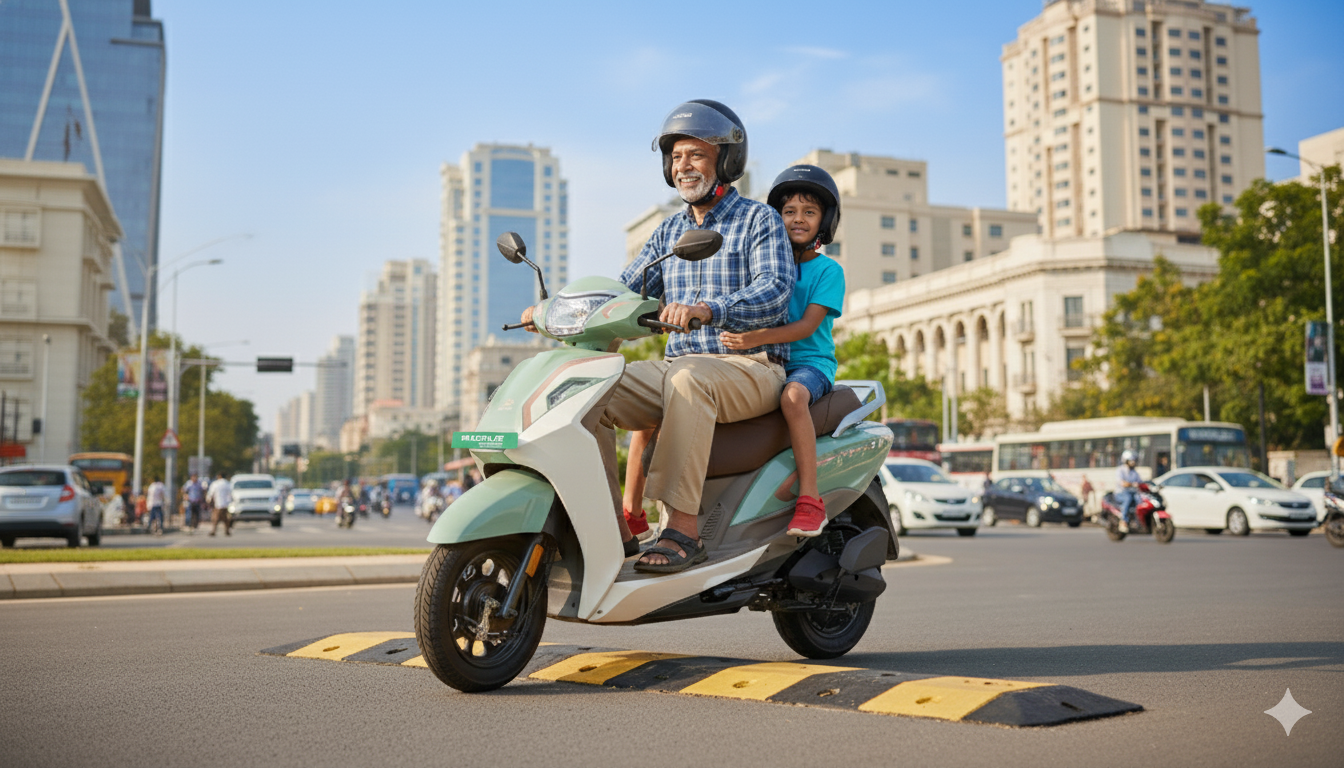
Every extra kilogram of load reduces your scooter's range. This is physics — heavier loads require more energy to accelerate and maintain speed. For daily commuters, this means two practical tips: avoid carrying unnecessary weight in the underseat storage, and for regular two-up riding, factor in 10–15% reduced range when planning longer trips with a pillion.
| Load Scenario | Approx Range Impact | Recommendation |
|---|---|---|
| Solo rider, light bag | Baseline IDC range | Optimal conditions |
| Solo rider, heavy bag (5+ kg) | ~5% reduction | Acceptable for daily use |
| Two-up riding (solo + pillion) | 10–15% reduction | Factor into trip planning |
| Heavy cargo on floorboard (8–10 kg) | Up to 15% reduction | Distribute weight centrally |
Seasonal Tips: Managing Range in Indian Summers
Indian summers are brutal on batteries. At ambient temperatures above 40°C, battery efficiency can drop noticeably. LFP batteries — used across the entire Ampere lineup — handle heat significantly better than NMC alternatives used by some competitors. However, some simple precautions still help in peak summer months: park in shade whenever possible, avoid charging immediately after a long ride in peak heat, and charge during cooler evening or night hours.
In cooler months (October to February in North India), range typically improves slightly. Monsoon season introduces another variable — wet roads and cautious riding in Eco mode often result in range being close to IDC figures because average speeds are lower.
Frequently Asked Questions
Can I actually achieve the IDC range in real life?
Yes, but it requires optimal conditions: Eco mode, solo rider, flat roads, moderate speed (40–50 km/h), and correctly inflated tyres. For most Indian urban riders, 75–85% of IDC range is the realistic daily expectation.
Does regenerative braking help extend range?
Ampere models recover some energy through the drivetrain during deceleration. In stop-and-go city traffic, this contributes meaningfully to overall range. It is not a dramatic recovery, but combined with smooth riding and Eco mode, it adds up.
Should I always charge to 100%?
For daily use, charging to 80–90% is kinder to the battery long-term. If you need maximum range for a longer trip, charge to 100% the night before. For daily 30–40 km commutes, stopping at 80% preserves battery health without any real-world range penalty.
My range has dropped noticeably. What should I check first?
Start with tyre pressure, riding mode, and recent load changes. If those are fine and range has dropped by 20–30% permanently, visit an Ampere service centre for a battery health check. The LFP batteries in Ampere scooters are rated for thousands of cycles, so significant early degradation is uncommon.
Maximising range is about building three or four simple habits — most of which also make your ride smoother and safer. Eco mode, correct tyre pressure, smooth throttle, and shade parking work together to give you the best possible range from your Ampere scooter every single day.
Select product
Enter your mobile number
Enter OTP

All your personal data is secured within the Ampere by Greaves Ecosystem

Enter your name
Your details are safe with us
All your personal data is secured within the Ampere by Greaves Ecosystem
Enter pincode
Our nearest dealership will reach out to you
Almost done
Share your email to receive updates (Optional)
